
Nutrition Notes
Creatine and Physical Output: An Editorial Survey of Published Research
Marcus Chen · 5 March 2026 · 10 min read
The editorial approach at Arelon Review prioritises documented observation over prescriptive advice. This piece began as a two-week note-keeping exercise: one editor, a structured daily supplement routine incorporating vitamin D and magnesium, and an attempt to record what a considered supplement stacking habit looks like in practice for an active man. The findings are observational, not definitive.
Vitamin D and magnesium are among the more frequently referenced nutrients in published supplementation literature for men with active lifestyles. The interest in vitamin D has grown considerably over the past decade, with a substantial body of nutritional research examining its contribution to daily energy rhythm and overall nutritional balance. Magnesium receives comparable attention in the context of muscle recovery rhythm after physical activity.
The pairing is not arbitrary. Several nutritional researchers have noted in published studies that the two nutrients share functional pathways in the body. This editorial does not draw conclusions from that observation — the relationship is noted simply as part of the context that led to the editorial decision to observe both simultaneously rather than in isolation.
The editor who undertook the two-week observation is an active man in his mid-thirties, with a gym attendance frequency of three to four sessions per week and a daily step count averaging approximately nine thousand. This context is noted not to generalise, but to establish the specific conditions under which the observations were recorded.

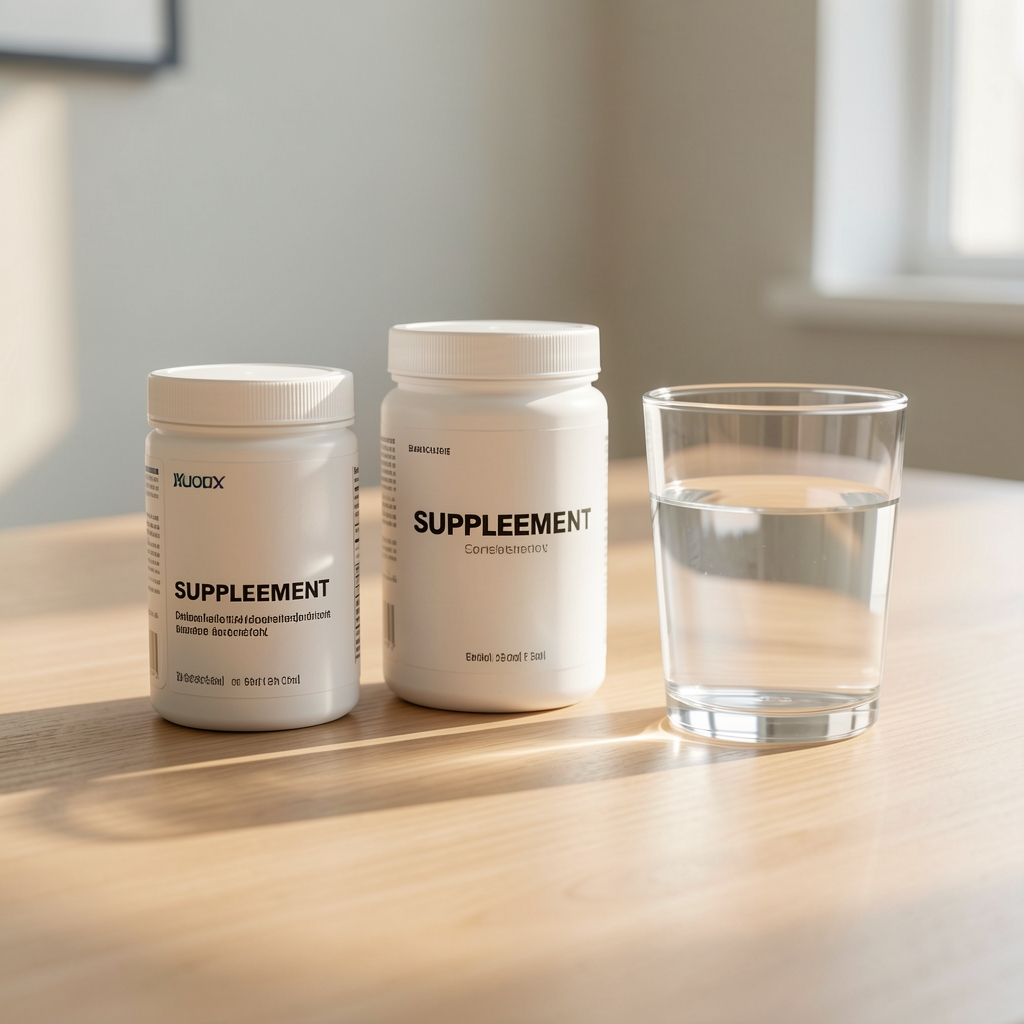
A daily supplement stack laid out before a morning session. The consistency of placement formed part of the routine itself.
The structure of a daily supplement stack matters almost as much as its composition, according to several nutritional journals reviewed for this piece. The sequence, the timing relative to meals, and the format of the supplement — whether oil-based or powder — all contribute to how consistently the routine is maintained over time.
For this observation, vitamin D was taken with the first meal of the day. The reasoning: vitamin D is fat-soluble, and published nutritional guidance consistently suggests pairing it with a meal that contains some dietary fat for optimal absorption context. This is not a direction, but an observation of what the literature suggests and how the editorial team applied that suggestion in practice.
Magnesium was placed in the evening routine, approximately forty-five minutes before sleep. This timing is observed in a portion of the nutritional literature as potentially supportive of relaxation rhythms. Again, the editorial note is descriptive: this is what was done, not what should be done universally. The timing was chosen based on published nutritional commentary, not on independent assessment.
The formats used: a vitamin D3 softgel with a standard daily serving, and a magnesium glycinate powder. The glycinate form was selected based on commentary in several published nutritional journals suggesting it tends to sit more easily in the digestive system for regular daily use compared with oxide forms. This selection was editorial, not advisory.
"The observation period revealed that the most significant factor was not which nutrients were taken, but whether the habit of taking them remained consistent across the fourteen days."
One theme that emerged consistently across the two-week observation was the relationship between nutritional awareness and supplement selection. The editor noted that on days when the overall dietary pattern was more varied — more whole foods, more colour on the plate, more protein from food rather than from supplemental sources — the supplement stack felt like a proportionate addition rather than a corrective measure.
This observation aligns with a position held consistently in published nutritional research: supplements are additions to a nutritional pattern, not replacements for it. The phrase "whole food first, supplement as addition" appears in various forms across the nutritional literature reviewed. It is a position Arelon Review holds editorially as well.
On days where the diet was less varied — heavier in processed options, lighter in vegetables, lower in overall protein from whole sources — the supplement stack felt, subjectively, less integrated into the broader day. This may be a psychological observation as much as a nutritional one, but it was noted as part of the field record regardless.
The editorial conclusion from this section is modest: men's nutritional habits form the context in which any supplement stack operates. The stack does not substitute for the context. This is not a novel conclusion — it is well-supported in the nutritional literature — but it is worth restating in an editorial format for an audience that may encounter supplement marketing which implies otherwise.
One of the more unexpected outcomes of the observation period was how the act of journalling the stack influenced the stack itself. Tracking each morning intake and each evening intake in a simple notebook — the format used by this editor — created a degree of accountability that persisted across the full fourteen days without requiring significant effort beyond the notation itself.
This is not a recommendation. It is an observation about how intentional daily routine and supplement stacking habits interact. The journal served as a lightweight accountability structure: because the act of recording was simple, the cost of missing a day became more visible. This made consistency more likely.
Several productivity and habit-formation researchers — notably outside the nutritional literature specifically — have written about the role of low-friction record-keeping in sustaining daily routines. The application of this principle to men's supplement routines is something the editorial team at Arelon Review considers worth exploring further in subsequent issues.
The specific journal format used: date, morning intake noted, evening intake noted, overall dietary quality rated on a simple three-point scale, and one sentence of context if relevant. Total time to complete the record each day: under two minutes. The simplicity was intentional and, the editor notes, likely necessary for the fourteen-day adherence rate.

Supplement journalling as a two-minute daily practice. The record kept itself once the format was established.
The sourcing of supplements is a subject that receives attention in the men's nutritional review space, often in ways that overstate the complexity or understate the basic questions worth asking. The editorial approach taken here is to focus on label literacy: the ability to read a supplement label and understand what it communicates and what it does not.
On the vitamin D label reviewed: the serving expressed in International Units, the form specified as D3 (cholecalciferol), the carrier oil noted as olive oil. These are the informative elements. The marketing language on the front panel — claiming various supportive properties — was not part of the editorial assessment. Arelon Review focuses on what the factual panel states, not on front-panel copy.
On the magnesium label: the form specified as glycinate, the elemental magnesium content per serving clearly stated, the absence of artificial colouring or flavouring noted. These distinctions matter for an active man constructing a daily supplement stack, because the form affects both the experience of taking the supplement and, according to several nutritional journals, the consistency of daily use.
The editorial position on sourcing: prioritise brands that are transparent about form, elemental content, and serving composition. Avoid brands whose label claims outpace their compositional transparency. This is not a professional directive — it is the editorial standard applied by this publication when reviewing products for coverage.
Articles published on Arelon Review are editorial in nature and reflect the writers' observations on everyday supplementation habits and nutritional awareness for active men. The content is not intended as professional advice, nor as guidance for the management of any specific condition. Readers with specific concerns about their daily routines are encouraged to speak with a qualified wellness professional.

Marcus Chen is the founding editor of Arelon Review. He writes on men's nutritional habits, supplement stacking practices, and the intersection of active lifestyle and daily wellness routines. Based in Jakarta.
More from this author →